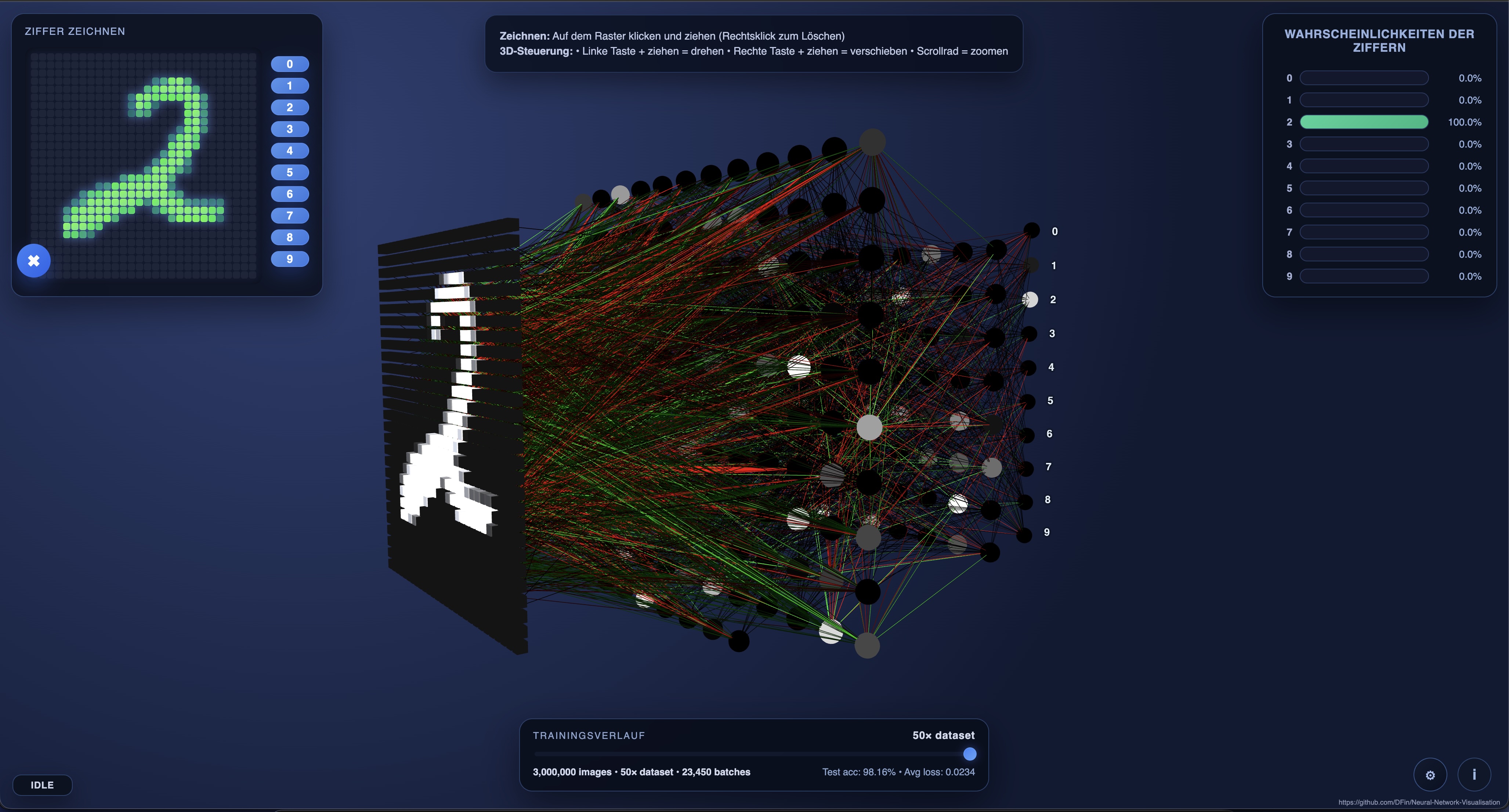
Interactive web visualisation for a compact multi-layer perceptron trained on the MNIST handwritten digit dataset. Draw a digit, watch activations propagate through the network in 3D, and inspect real-time prediction probabilities.
This is still in a rough state and under active development. If you want something useable for a museum etc check back later. I have a couple of features in mind (like being able to connect a tablet to draw a number) to make this a good educational visualisation.
index.html/assets/– Static Three.js visualiser and UI assets.exports/mlp_weights.json– Default weights with timeline snapshots (generated from the latest training run).training/mlp_train.py– PyTorch helper to train the MLP (with Apple Metal acceleration when available) and export weights for the front-end.
-
(Only for training) Install Python dependencies (PyTorch + torchvision):
python3 -m pip install torch torchvision
-
Launch a static file server from the repository root (any server works; this example uses Python):
python3 -m http.server 8000
-
Open
http://localhost:8000in your browser. Draw on the 28×28 grid (left-click to draw, right-click to erase) and explore the 3D network with the mouse or trackpad.
training/mlp_train.py trains a small MLP on MNIST and writes a JSON export the front-end consumes. Metal (MPS) is used automatically when available on Apple Silicon; otherwise the script falls back to CUDA or CPU.
Typical usage:
python3 training/mlp_train.py \
  --epochs 5 \
  --hidden-dims 128 64 \
  --batch-size 256 \
  --export-path exports/mlp_weights.json
Key options:
--hidden-dims: Hidden layer sizes (default128 64). Keep the network modest so the visualisation stays responsive.--epochs: Minimum training epochs (default5). The script will automatically extend the run so the timeline hits the 50× dataset milestone.--batch-size: Mini-batch size (default128).--device: Forcemps,cuda, orcpu. By default the script picks the best available backend.--skip-train: Export the randomly initialised weights without running training (useful for debugging the pipeline).
After training, update VISUALIZER_CONFIG.weightUrl in assets/main.js if you export to a different location/name. Refresh the browser to load the new weights.
Every exported JSON now includes a timeline array spanning 35 checkpoints: densely spaced early snapshots (≈50, 120, 250, 500, 1k, 2k, 3.5k, 5.8k, 8.7k, 13k, 19.5k, 28.5k, 40k images), followed by dataset-multiple milestones from 1× through 50×. The JSON manifest stays small; each snapshot’s weights are stored separately as float16-encoded files under exports/<stem>/NNN_<id>.json, and the front-end streams them on demand so you can scrub the timeline without downloading the entire 50× run up front. Re-export the weights with the updated script to generate fresh timeline data for your own runs.
- The visualiser highlights the top-N (configurable) strongest incoming connections per neuron to keep the scene legible.
- Colors encode activation sign and magnitude (cool tones for negative/low, warm tones for strong positive contributions).
- The default export (
exports/mlp_weights.json) already includes timeline milestones from a multi-epoch training run. Retrain (and re-export) if you want to showcase a different progression. - If you adjust the architecture, ensure the JSON export reflects the new layer sizes; the front-end builds the scene dynamically from that metadata.
Keep production files under the repo-local releases/ tree (ideal for /srv/server/nn-vis on the new host):
releases/current/– files served by nginx.releases/backups/<timestamp>/– immutable snapshots for quick rollback (each stamped with the commit hash in.commit).releases/.deploy_tmp/– staging area used during deployment.
From the repo root run:
./deploy.sh [commit-ish]When no commit is supplied it deploys HEAD. The script exports the requested commit, stages it under .deploy_tmp/, then rsyncs into releases/current/ and a timestamped backup. Point nginx at the current directory, e.g.:
server {
    server_name nn-vis.noelith.dev;
    root /srv/server/nn-vis/releases/current;
    index index.html;
    location / {
        try_files $uri $uri/ /index.html;
    }
}
Issue TLS certs via certbot --nginx -d nn-vis.noelith.dev once the site block is enabled.