Integrating the RAPTOR foundation policy #26082
Conversation


bump

compiles and raptor mode appears

hovering with RAPTOR seems to work

Using Raptor to execute offboard commands works (using multirobot f03825a5795a77c5a095f799eeb8e0b646fe7176 to feed the trajectory_setpoint). Requires more testing

simplified rotmat

runtime inference frequency multiple

arming request response reflects actual readiness

adjusting to fit IMU gyro ratemax

relaxing control timing warning thresholds for SITL

Using mode registration to signal if offboard commands should be forwarded to trajectory_setpoint instead of just hardcoding vehicle_status.nav_state == vehicle_status_s::NAVIGATION_STATE_OFFBOARD

adopting new "request_offboard_setpoint" in raptor module

replace offboard seems good

mc_raptor: overwrite offboard parameter

separate raptor config

addendum

Raptor off by default

RAPTOR readme

Loading raptor checkpoint from tar works.

check if load was successful

refactoring: cutting out the pure C interface to allow direct testing of the policy input/output behavior from the file, without fully loading it into memory first

adapter not needed anymore

ripping out test observation mode (not used in a long time)

fixing warnings

bump RLtools to fix the remaining warnings

Loading RAPTOR checkpoint from sdcard seems to work on FMU-6C

embedding Raptor policy into flash works again

also printing checkpoint name when using the embedded policy

cleaner handling of the checkpoint name

back to reading from file

ripping out visual odometry checks

cleaner

more debug but no success

bump rlt

bump

pre next rebase

we can publish the no angvel update because we latch onto it with the scheduled work item anyways

this kind of runs on the 6c

still bad

SIH almost flying

saving stale traj setpoint yaw

new error. timestamp not the problem anymore

bump rlt; SIH works with executor

shaping up

bumping blob (include tar checkpoint)

cleaning up

fixing formatting

update readme
bump

compiles and raptor mode appears

hovering with RAPTOR seems to work

Using Raptor to execute offboard commands works (using multirobot f03825a5795a77c5a095f799eeb8e0b646fe7176 to feed the trajectory_setpoint). Requires more testing

simplified rotmat

runtime inference frequency multiple

arming request response reflects actual readiness

adjusting to fit IMU gyro ratemax

relaxing control timing warning thresholds for SITL

Using mode registration to signal if offboard commands should be forwarded to trajectory_setpoint instead of just hardcoding vehicle_status.nav_state == vehicle_status_s::NAVIGATION_STATE_OFFBOARD

adopting new "request_offboard_setpoint" in raptor module

replace offboard seems good

mc_raptor: overwrite offboard parameter

separate raptor config

addendum

Raptor off by default

RAPTOR readme

Loading raptor checkpoint from tar works.

check if load was successful

refactoring: cutting out the pure C interface to allow direct testing of the policy input/output behavior from the file, without fully loading it into memory first

adapter not needed anymore

ripping out test observation mode (not used in a long time)

fixing warnings

bump RLtools to fix the remaining warnings

Loading RAPTOR checkpoint from sdcard seems to work on FMU-6C

embedding Raptor policy into flash works again

also printing checkpoint name when using the embedded policy

cleaner handling of the checkpoint name

back to reading from file

ripping out visual odometry checks

cleaner

more debug but no success

bump rlt

bump

pre next rebase

we can publish the no angvel update because we latch onto it with the scheduled work item anyways

this kind of runs on the 6c

still bad

SIH almost flying

saving stale traj setpoint yaw

new error. timestamp not the problem anymore

bump rlt; SIH works with executor

shaping up

bumping blob (include tar checkpoint)

cleaning up

fixing formatting

update readme

updating gitignore

|
|
||
| if (vehicle_status.nav_state == vehicle_status_s::NAVIGATION_STATE_OFFBOARD) { | ||
| // only publish setpoint once in OFFBOARD | ||
| if (vehicle_status.accepts_offboard_setpoints) { |

There was a problem hiding this comment.
So your raptor is implemented an external mode like offboard and you still want to publish trajectory setpoints? As long as this still works for offboard this is OK.
I don't understand what Raptor is - foundation policy sounds like some kind of corporate or academic doublespeak. Can you please explain it in little words (I'm a tech writer).
What does it do, who would want to use it, how can they enable it.
This also needs docs enough to answer that.
There was a problem hiding this comment.
Yes exactly, it uses the mode registration to register a new mode. I think this is the cleanest way to separate it from the other parts of the control stack and it was also requested by @AlexKlimaj here .
We chose the term "foundation policy" because the way it is trained and the way it works resembles foundation models. "Policy" is the standard term in the reinforcement learning community, it is equivalent to "controller" in the robotics community.
What does it do:
The idea is to have an adaptive policy, that can quickly adapt to any quadrotor by observing its response and adapting its control behavior. The goal is to get rid of the requirement for PID tuning and to be more robust wrt. disturbances or other changes in the dynamics. It is an end-to-end policy, meaning it takes state information (position, orientation, linear velocity, angular velocity) as input and directly outputs motor commands (actuator motors). Please refer to this video: https://www.youtube.com/watch?v=hVzdWRFTX3k and for more details to the paper: https://arxiv.org/abs/2509.11481
Who would want to use it:
Mainly academic use at this point (which is only the beginning), e.g. as a baseline for alternative control methods, but possibly also some commercial use-cases, where, e.g. the hardware (or payload) is changed often and the cost for tuning the controllers is prohibitive.
How can they enable it:
Please refer to the instructions: #26082 (comment). But I also plan to make a short video that shows how to use it step-by-step on a Holybro x500 v2 for the documentation.
I hope I find time to work on the docs in the next days. I'm conducting real-world flight tests for this PR right now
There was a problem hiding this comment.
Thanks very much. So this sounds a bit like https://docs.px4.io/main/en/advanced/neural_networks to me. That's just an observation, but it does mean we need to think about positioning this, and if they have overlap, grouping them.
There was a problem hiding this comment.
Sorry for the late response but I wanted to do some more thorough real-world testing. I have added documentation in docs/en/advanced/raptor.md, including an interactive playground to test the RAPTOR policy in simulation as well as a trajectory parameter generator app. Please let me know what you think
…etpoint (use the position and yaw at activation time as reference instead)
| @@ -0,0 +1,72 @@ | |||
| # RAPTOR | |||
There was a problem hiding this comment.
FWIW this is the sort of stuff you'd have in the docs, then link to the docs from here if you need a readme.
There was a problem hiding this comment.
Added docs in docs/en/advanced/raptor.md

|
@SindreMHegre Could you have a look? |

@Jaeyoung-Lim I think I have time for this tomorrow, will take a look then. But this sounds really promising, adding SD card storage of the network and sending setpoints over Mavlink are huge upgrades over my work! I tried a bit on the setpoints but weren't able to within the time limit of my work. |
…s); reverting accidental .gitignore modification

 SindreMHegre
left a comment
SindreMHegre
left a comment
SindreMHegre
left a comment
There was a problem hiding this comment.
I did not have time to look into the details of the actual mc_raptor.cpp and hpp files. But it looks a lot like my module. I think it's really nice to have both options so I think its best to merge the documentation somewhat in the top script and then divide into to sub files for module specific information. If you have any specific questions @jonas-eschmann don't hesitate to ask, and it looks like you've already looked at the mc_nn_module, but if you need the full history you can find it here. It would be really cool to get the possibility to send mavlink setpoints to the mc_nn_module as well, but I can try to ping the lab at NTNU if it's not a quick fix possible to integrate into this PR. The same goes for storing the networks on the SD card, super usefull upgrade that would be great for the mc_nn_control. I still thinks mc_nn_control still has a place in PX4, as it supports using different frameworks and could still be used for other things than control! Really nice to see the possibilities for NNs in PX4 expand and improve!!!!
boards/px4/fmu-v6c/raptor.px4board
Outdated
| CONFIG_SYSTEMCMDS_VER=y | ||
| CONFIG_SYSTEMCMDS_WORK_QUEUE=y | ||
| CONFIG_LIB_RL_TOOLS=y | ||
| CONFIG_MODULES_MC_RAPTOR=y |
There was a problem hiding this comment.
Alphabetically sorted?
There was a problem hiding this comment.
Good point! I wasn't aware they should be sorted. I sorted ./boards/sitl/raptor.px4board and boards/px4/fmu-v6c/raptor.px4board
boards/px4/sitl/raptor.px4board
Outdated
| CONFIG_LIB_RL_TOOLS=y | ||
| CONFIG_MODULES_MC_RAPTOR=y |
There was a problem hiding this comment.
alphabetically sorted?
|
|
||
| uint8 executor_in_charge # Current mode executor in charge (0=Autopilot) | ||
|
|
||
| bool accepts_offboard_setpoints # True if the current mode accepts offboard trajectory setpoints via MAVLink |
There was a problem hiding this comment.
shouldn't message version be bumped here as well?
There was a problem hiding this comment.
Thanks a lot for the hint! I bumped the version and archived the old one
|
Also, if this can be used on Ubuntu versions prior to 24, then it should be clear in the docs, as the mc_nn_control module does not, so for those on older versions it would be great with a plug and play neural module |
…er Mavlink is too noisy). Quite agile trajectory tracking, good performance
|
@SindreMHegre Wouldn't it be better to make the Aerial gym training work with the dynamic loading of neural networks? For me I think it might be a good opportunity to get rid of the tfmicro dependency, and the convoluted CMake hacks we had to go through if we can make them share the neural network infrastructure. |

Co-authored-by: Hamish Willee <hamishwillee@gmail.com>


|
No flaws found |

|
@SindreMHegre Thanks a lot for the review! Your implementation, particularly using the external mode registration, was very useful as a guide! We have had an out-of-tree module solution (one-line modification to PX4 to use
This should work on any OS/version, as long as the C++ compiler supports C++17 (GCC/Clang/MSVC releases from 2017/2018 onwards). In the meantime, I have also conducted extensive outdoor flying tests using
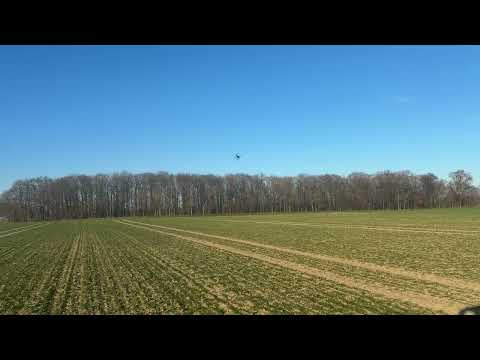
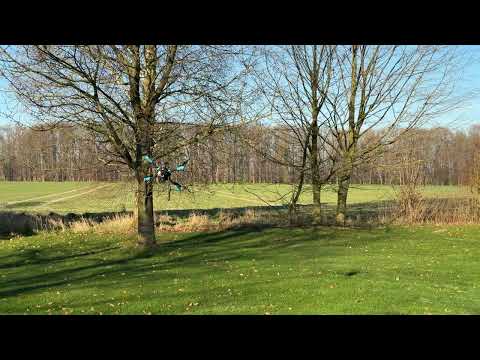
Videos (links to YouTube): I have also added relatively extensive documentation in @Jaeyoung-Lim Please let me know how to proceed |
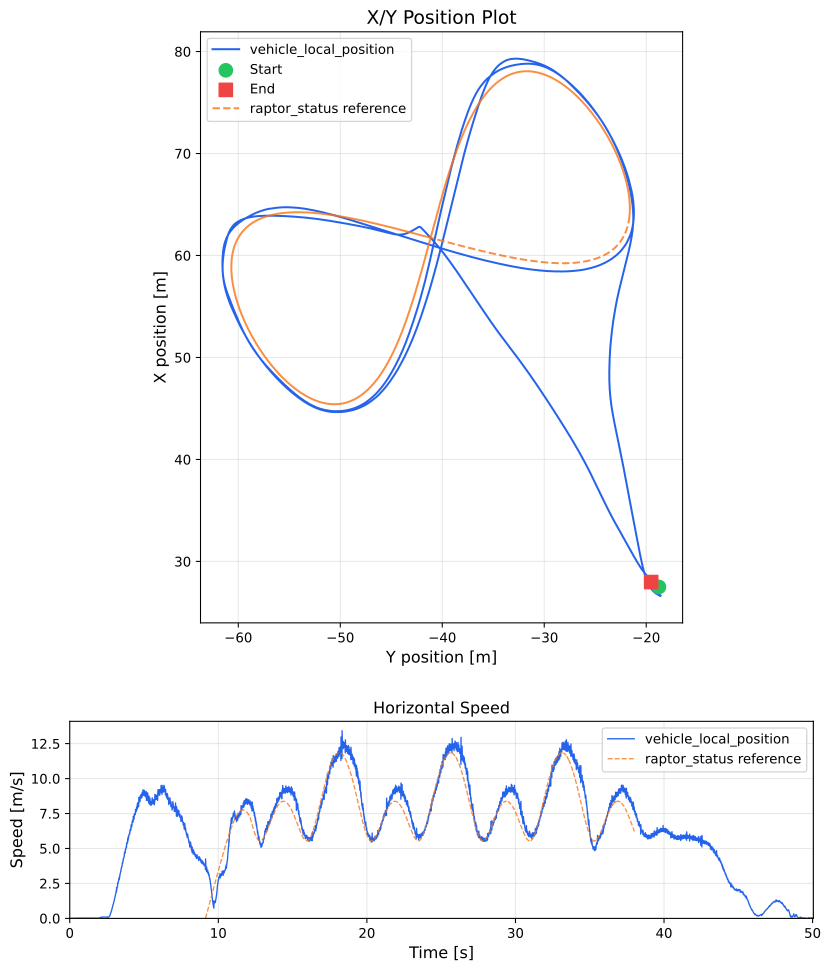
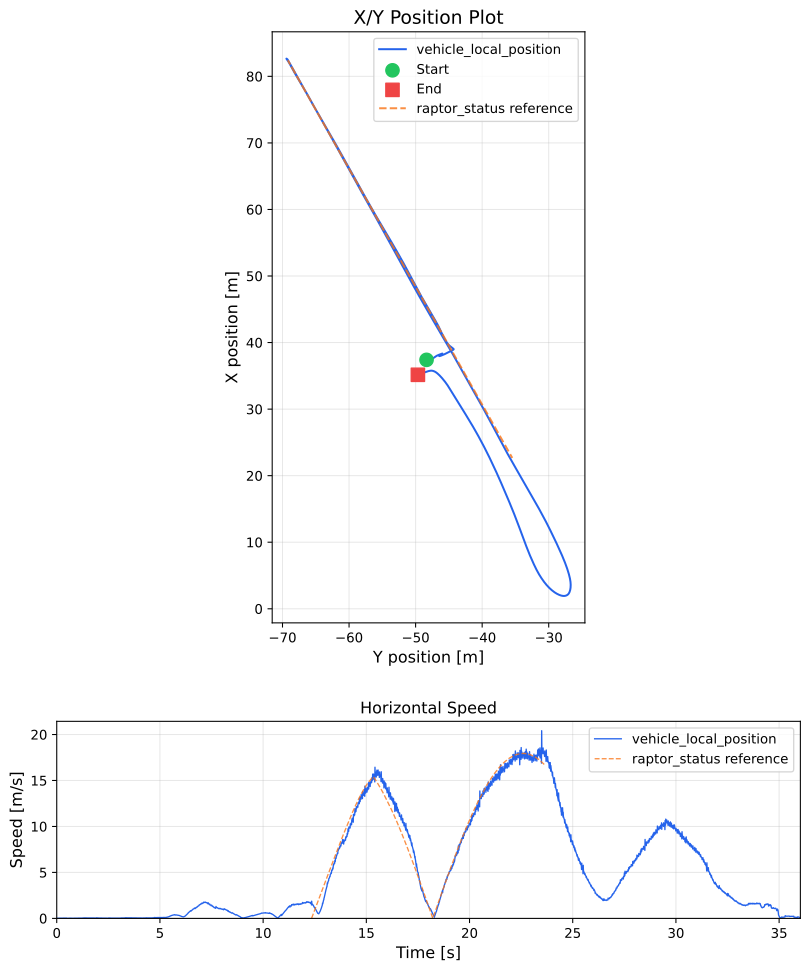

| uint64 timestamp # [us] Time since system start | ||
| uint64 timestamp_sample # [us] Sampling timestamp of the data this control response is based on | ||
| bool subscription_update_angular_velocity # [bool] Flag signalling if the vehicle_angular_velocity was updated | ||
| bool subscription_update_local_position # [bool] Flag signalling if the vehicle_local_position was updated |
There was a problem hiding this comment.
FYI, there is no convention for bool metadata - i.e. you can infer this from the field so it can't have a unit. That said, aguably this is more clear. Let's leave it in and I'll fix globally.
| - [Neural Networks](advanced/neural_networks.md) | ||
| - [Neural Network Module Utilities](advanced/nn_module_utilities.md) | ||
| - [TensorFlow Lite Micro (TFLM)](advanced/tflm.md) | ||
| - [RAPTOR: A Foundation Policy for Quadrotor Control](advanced/raptor.md) |
There was a problem hiding this comment.
@SindreMHegre We need to put these both under a parent topic, and the logical name for that topic is IMO "Neural Networks". That means we'll need to push your doc one deeper and give it a distinct name.
Would you be happy to rename your module top level "Multicopter Neural Network Module (NN)"? I can then move it as needed.
So it would look like
- Neural Networks - a parent topic linking to both these solutions
- Multicopter Neural Network (NN) - your current top level topic
- RAPTOR (or whatever name we use)
There was a problem hiding this comment.
By whatever name we use I mean something like "RAPTOR Adaptive RL Neural Module" or similar. Something that is accessible and findable by someone just learning about neural nets.
There was a problem hiding this comment.
I agree that it makes sense to structure it like you propose!
Maybe: "RAPTOR: Adaptive Neural Controller"? Or if you want to include RL: "RAPTOR: RL-Based Adaptive Neural Controller"?
docs/en/advanced/raptor.md
Outdated
| @@ -0,0 +1,212 @@ | |||
| # RAPTOR: A Neural Network Module for Quadrotor Control | |||
There was a problem hiding this comment.
As discussed, the previous name "RAPTOR: A Foundation Policy for Quadrotor Control" is not suitable for this context.
It might make sense from an academic point of view where all your readers are machine learning experts, but it immediately makes what is otherwise an interesting technology far less likely to be discovered.
To "fix" this I have renamed to something that someone ignorant (i.e. me) might find useful for discovery). I have also added a two paragraph summary so that people can differentiate it from the other topic without having to read both in detail. I have tried to capture that this is a module that you can use with many frames without having to retune.
You are free to suggest an alternative - because I might be completely off base with what this is - but we should try and target non-experts as far as possible.
There was a problem hiding this comment.
Thanks a lot for your re-writing and editing, I think it is great! I would just sneak "Adaptive" into the title because the capability to adapt to a wide range of platforms (as you describe well) is the main point of distinction to other approaches and especially the existing NN-based control module.
docs/en/advanced/raptor.md
Outdated
|
|
||
| #### Internal Reference | ||
|
|
||
| To use the internal reference generator (Position and Lissajous only for now): |
There was a problem hiding this comment.
What is an internal reference? What is Position, What is Lissajous?
Do these matter? Or to put it another way, can the point of this section be dumbed down to be useful to a graduate engineer level - someone who knows about UAVs but little about neural nets.
There was a problem hiding this comment.
Good point! I have added clarifications on why the internal reference trajectory generator is needed and a brief description on what the Lissajous parameterization does. Essentially, it is used to e.g. generate smooth figure-eight trajectories of varying agility to test the control behavior and tracking error. I have also added a link to the Lissajous article on Wikipedia and added a reference to the embedded tool for adjusting the Lissajous parameters to see the resulting trajectories
docs/en/advanced/raptor.md
Outdated
|
|
||
|  | ||
|
|
||
| RAPTOR is a foundation policy for end-to-end quadrotor control. |
There was a problem hiding this comment.
Again, I still really don't understand what a foundation policy is, and maybe 0.001% of people here will. You should either use other words or define it. Unless you don't want people to use this?
There was a problem hiding this comment.
Fair enough! We refer to it as a "foundation policy" because of the parallels to foundation models for language modelling (LLMs). In particular, the aspects of 1. Pre-training on a diverse dataset and 2. In-context adaptation. But I think adding these extensive explanations would bloat this documentation, which should probably focus on what it does and how it can be used. People who are interested in more details can then refer to the video and the paper for more details. So tldr: I agree and removed the "foundation policy" framing
@Jaeyoung-Lim I agree that dynamic loading of neural networks is much better, I don't know if we should get rid of the old module just yet. My main goal was to make it easier for people who already has a reinforcment learning setup to deploy their policies to cheap COTS hardware to perform real world tests and easily modify anything they might want to. Please correct me if I'm wrong @jonas-eschmann but this module seems to be more tailored to the specific policy and rl-tools, I'm unsure of how easy it is to covert any pre-existing policy to the rl-tools format and then deploy it through this module. I did look into rl-tools when starting to make my module and it looked great (and probably even better now), but I wanted people to be able to use their existing frameworks and not have to switch. If this is possible with this module then there is no big reason to keep my original module, and I think this raptor module is better if you are starting from scratch.
That is the same as TFLM, so then it can probably only build out of the box on Ubuntu 24 and onwards. You can manually install a newer GCC version on older Ubuntu versions though.
@hamishwillee that sounds great, completely agree. And as you discussed above, the first landing page directly under the "Neural Networks" heading should explain the differences. I think the list under features for the rapor policy is nice to copy over to the landing page. To my understanding the raptor module is better if you are starting from scratch or want to play around with a pre-trained network (it looks like it performs a lot better on the x500 than my network did) you should go with the raptor module. If you have a pre-existing setup you want to use or a strong wish to use other frameworks, like PyTorch or TF then maybe the mc_nn_module is a better fit. Could possibly also add a link to my thesis in the mc_nn_control docs now that it's publically available, as this describes my process in great detail to anyone wanting to do something similar. https://nva.sikt.no/registration/019b26689144-efeebae8-84d6-4413-ad7f-9aceb4ff7374 Does the raptor module accept manual setpoints, as in using the sticks on a RC controller? That could potentially also be a difference as my module does accept it (although not recomended) |
4 participants


As requested by @mrpollo here I moved the Raptor implementation from an out-of-tree module into a proper in-tree module. It uses the external mode registration.
Raptor is an end-to-end foundation policy that takes position, orientation, linear velocity and angular velocity as inputs and outputs motor commands (
actuator_motors). The policy is adaptive and can control virtually any quadrotor, zero-shot. We tested it on 10 different real quadrotors (from 30g to 2.4kg). More info can be found here: https://raptor.rl.tools/.The goal of this integration is to provide a baseline for reinforcement learning-based quadrotor control research. This module is a robust baseline as well as a starting point for researchers and practitioners to train and deploy their own end-to-end control policies.
A highlight feature of this new implementation is that the neural network weights can be loaded from the SD card and (unlike the
nn_mc_controlmodule) do not need to be compiled into the firmware. This drastically reduces the flash usage and allows testing new neural networks without re-flashing the flight controller and remotely by transferring the checkpoint via Mavlink FTP.The policy is trained for position control (controlling the position error to zero) but as we show in the paper also performs well for trajectory tracking (by offsetting position and linear velocity with the desired values from the trajectory). Hence, this module supports receiving
trajectory_setpoint. The problem is that the forwarding of the trajectory setpoint from Mavlink is hardcoded to require the offboard mode inmavlink_receiver.cpp. Because of this we propose to add arequest_offboard_setpointsinto the mode registration request. In combination with minimal adjustments in the commander and mode management, this allows to forward the setpoint in a configurable way.The neural networks are trained and run using RLtools, a pure C++, dependency-free, header-only library. It was created with a major focus on stability and is maintained by me. Compared to e.g. Tensorflow Lite I expect it to cause less issues going forward due to its simplicity.
We tested the previous implementation (OOT module) extensively on three different real platforms. This implementation shares major parts of the code with that but has not been tested on a real platform, yet (I will hopefully be able to test it next week). But I tested it in the SITL and SIH. These are the steps I use to run it:
SITL
Standalone Usage (Without External Trajectory Setpoint)
Build PX4 SITL with Raptor, disable QGC requirement, and adjust the
IMU_GYRO_RATEMAXto match the simulation IMU rateUpload the RAPTOR checkpoint to the "SD card": Separate terminal
restart (ctrl+c)
Note the external mode ID of
RAPTORin the status reportUsage with External Trajectory Setpoint
Send Lissajous setpoints via Mavlink:
SIH
In QGroundControl:
New terminal (optional):
New terminal: